






A clearer next step in a noisy job search
Job hunting creates a collection problem as well as a writing problem. Roles arrive through search, links, and email alerts; deciding which ones fit means repeatedly comparing their requirements with a CV.
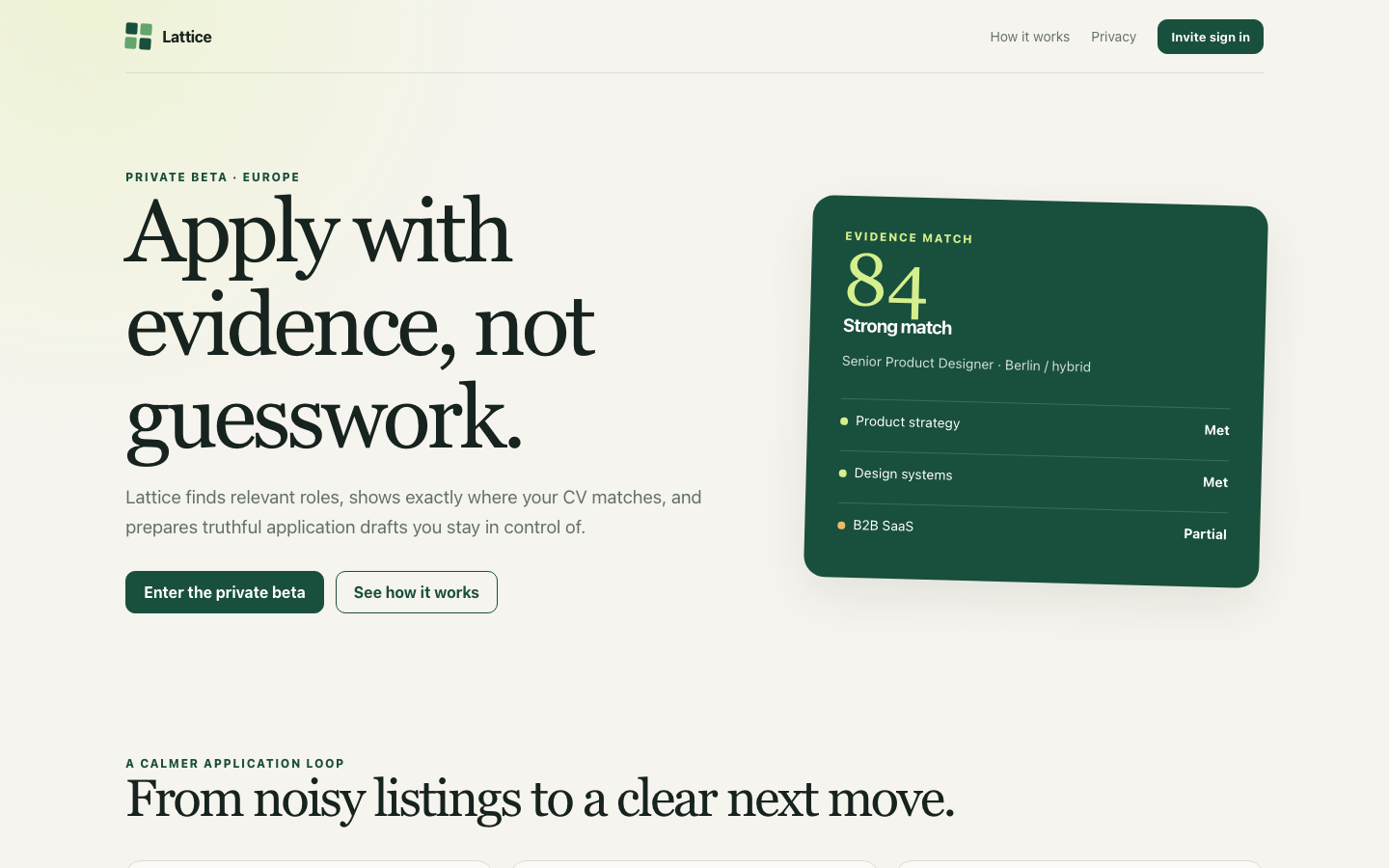
I built Lattice, an invite-only European job-application MVP, to turn that loop into a reviewed profile, an evidence-led match, and an editable application kit.
What I implemented
- A reviewed CV profile. PDF/DOCX ingestion creates a structured profile that the user checks before matching begins. Replacing the CV invalidates stale analyses.
- Multiple ways to collect roles. Manual URL/text import, forwarded email alerts, and country-aware Adzuna discovery feed a deduplicated workspace.
- Evidence-led analysis. Deterministic eligibility and scoring work alongside AI explanations. Strengths and proposed edits must be traceable to supplied evidence.
- Application kits and tracking. Users prepare drafts, record applications, and follow interview or offer stages. Sending remains their decision.
The engineering challenge
The system has to stay coherent when inputs change or a provider retries. I added versioned profiles, idempotent analysis runs, atomic quotas, bounded workers, and retry handling. Supabase row-level security and private storage keep each user's CV and job data isolated.
The documented checks cover normalization, import safety, scoring, evidence rules, and an anonymized evaluation corpus.
Current stage
The MVP is implemented. Acceptance of the external CV, email, job-discovery, and model integrations still requires configured staging credentials. The source is private; I can walk through the architecture and product flow.