






One model, many translation directions
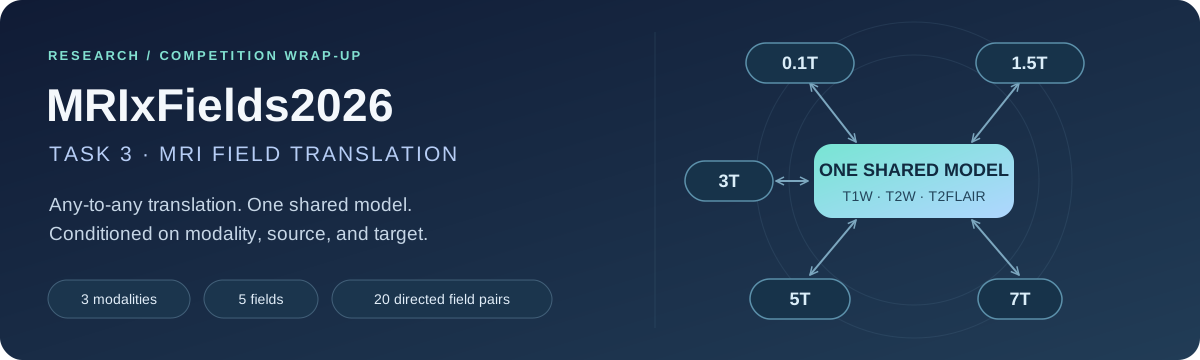
MRI appearance changes with the scan modality and magnetic field strength. MRIxFields2026 Task 3 asks for controllable translation between those domains, including translations toward lower fields.
Our inzvamri team received a Third Prize in Task 3. My work focused on adapting FPS-Former into a shared conditional model and making its inference and submission workflow reproducible.
My contribution
I adapted the frequency, spatial, and multi-scale architecture for field translation, conditioning an approximately 11.5M-parameter model on modality and source/target field strength.
The workflow covers T1W, T2W, and T2FLAIR, all twenty non-identity field pairs, and a complete 180-prediction validation submission. I also built checks for output domains, spatial metadata, numerical values, and archive structure.
Recorded results
| Metric | First recorded run | Best recorded run |
|---|---|---|
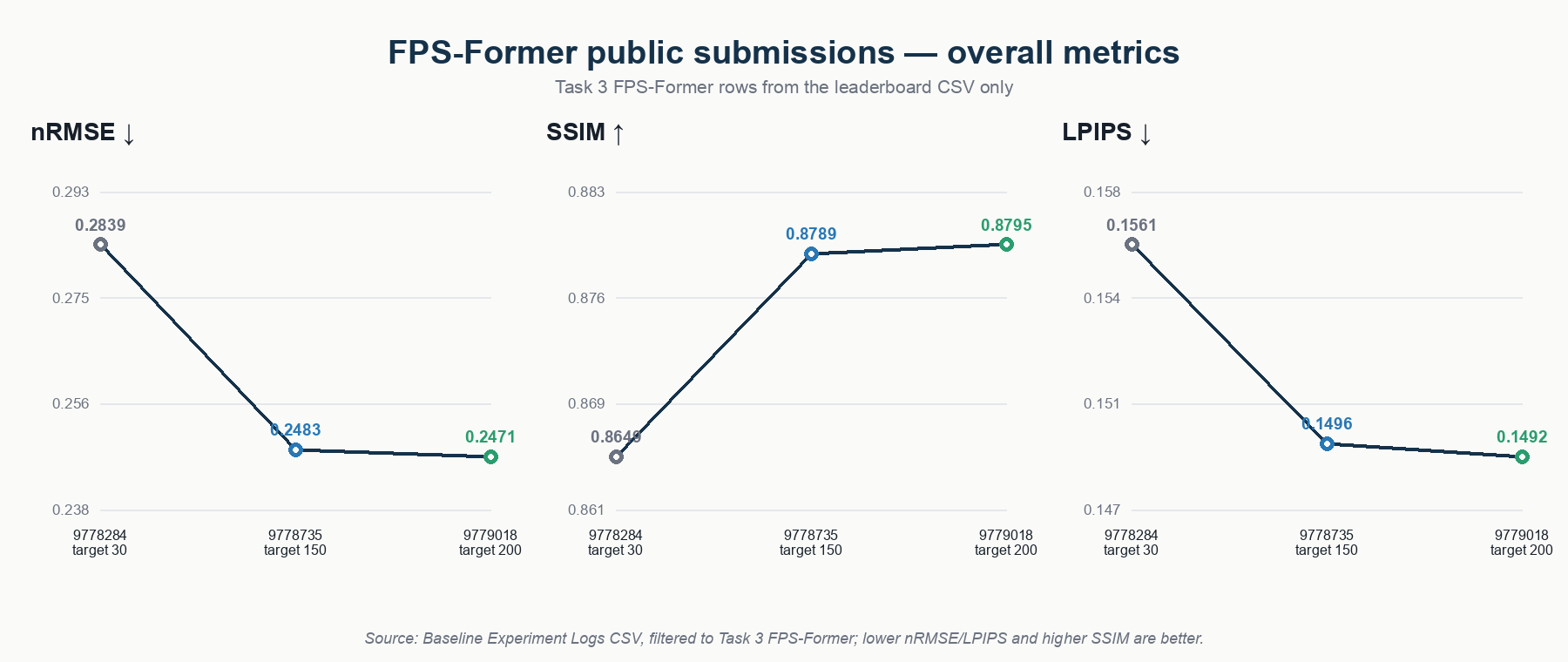
| nRMSE ↓ | 0.283937 | 0.247053 |
| SSIM ↑ | 0.864881 | 0.879531 |
| LPIPS ↓ | 0.156116 | 0.149198 |
nRMSE improved by 13.0% across these experiments. Patch and batch settings also changed, so this is a comparison of successive runs rather than an isolated test of training duration. The team award and these personal validation results describe different parts of the competition outcome.
What I learned
Lower training loss did not always produce better local translation metrics. That made it essential to keep training diagnostics, local holdouts, and public validation results distinct—and to audit the complete prediction pipeline alongside the model.